
Outdoor Christmas lights: what sets professional lights apart from cheap ones?
Technical guide to understanding what lies behind the price differences in outdoor string lights and professional Christmas decorations

Date
31.07.2026
Reading time
15 min
Why do some lights cost so little?
We are often asked this question, especially by those looking for professional outdoor Christmas lights or high-quality outdoor string lights. It comes from professionals decorating squares and shopping centres, and from customers decorating their home balcony. The substance is always the same: “Why can I find outdoor Christmas lights on the market for 5 euros, while yours cost much more?”
We also read it in comments on social media: “Too expensive!”. And the reaction is understandable. Who has time to study the technical specifications of a string light? We are all busy with a thousand things, and after all, we are talking about Christmas lights — what could possibly be so complicated?
But first, let us immediately clear up one fundamental point.
When you switch on a quality decoration and a cheap one for the first time, they look practically the same. That is precisely the beauty of decorative lights: they always create wonder in those who look at them, they always give that moment of happiness — regardless of the price paid.
The difference, however, becomes visible over time. It becomes visible after weeks of rain, after months of exposure to the sun, after a few years of installations and dismantling. And that is where construction choices make all the difference in the world.
LED quality
It would be natural to think that the LED is the most expensive component of a string light. It seems logical, doesn’t it? In reality, this is not always the case. LEDs have been used in decorations for many years now; old filament bulbs have practically disappeared — paradoxically, if someone still wanted to use them, they would cost more than LEDs.
The point is that not all LEDs are the same. The differences in quality are enormous, with price variations of several multiples. And the problem is this: it is impossible to distinguish a quality LED from a cheap one simply by looking at it. To the naked eye, they are identical. The difference is all in the numbers.
1. Energy efficiency
A quality LED produces the same amount of light while consuming less energy. The difference on the electricity bill, it must be said, is not the most decisive factor — in light decorations, consumption remains low. However, it is an important indicator of the LED’s build quality: a more efficient chip is also a better-manufactured chip.
2. Durability over time
Important: the lifespan of an LED is not measured by whether “it switches on or does not switch on”. It is measured by how long the brightness remains above 75% of its initial value. A quality LED maintains its performance for many seasons of use. A cheap one declines much faster — after just the first season, lights that were once bright become dull, weak, lifeless.
3. Colour consistency between batches
This is an aspect few people know about, but it drives anyone who works with lights mad. Maintaining exactly the same light shade from one production batch to the next is extremely expensive. The process is called binning: each individual LED is measured and classified to fall within a very narrow tolerance range.
In cheap products, this selection is absent or approximate. The result? You buy two string lights of the same model, place them next to each other, and one is warm white while the other tends towards greenish. For a professional decorating an entire avenue, it is a disaster.
4. LED insulation and protection
Here is a point that is often ignored, but crucial for outdoor installations.
Resin-coated LEDs — these are LEDs placed inside transparent polycarbonate capsules and completely filled with epoxy resin. This creates a total barrier against humidity, oxidation and weathering. They are decorations designed to remain outdoors for a long time, even for several continuous months.
Non-resin-coated LEDs — these have simpler insulation. In cheaper versions, they last only a few weeks outdoors before oxidation does its work. Intermediate solutions with better processes do exist, but they cost more. And the most deceptive thing? From the outside, you cannot see any difference. To understand it, you would have to break the LED coating.

| Feature | Quality LED | Cheap LED |
|---|---|---|
| Energy efficiency | High: more light, less consumption | Low: consumes more for the same output |
| Lifespan (>75% brightness) | Many seasons of use | Visible decline after just the first season |
| Colour consistency | Tight binning: uniform shade | Clear variations between one batch and another |
| Insulation | Complete epoxy resin coating | Minimal: a few weeks outdoors |
The electrical cable: the hidden cost of outdoor string lights
If there is one component that has changed the price balance in light decorations in recent years, it is the electrical cable. In many products, it has become the component that has the greatest impact on the final cost — more than the LED itself. To understand why, you need to look at three things: the conductor cross-section, the material it is made from and the outer coating.
1. Cable cross-section
The cross-section indicates how wide the “road” is for the current to pass through. The thinner the cable, the more resistance increases, with all the consequences this entails (heat, loss of brightness, risks). The harmonised technical standards relating to the Low Voltage Directive 2014/35/EU set precise minimums: 0.5 mm² for Class II string lights (mains voltage, below 250V) and 0.15 mm² for Class III string lights (low voltage). Going below these values makes the product non-compliant, yet it happens.
2. Copper versus aluminium
Copper has always been the conductive material par excellence. But its price has soared in recent years, also driven by global demand for data centre infrastructure. The result? Many manufacturers have started using aluminium, or a copper and aluminium mix, to keep costs down.
In low-voltage decorations, the regulation allows this. But what nobody says are the major technical compromises involved in this choice.
| Aspect | 100% copper | 50/50 copper/aluminium mix |
|---|---|---|
| Electrical resistance | Low | Higher |
| Light uniformity | Constant along the entire string light | Visible drop over long distances |
| Cable heating | Minimal | Higher, especially in long string lights |
| Solder joint durability | Strong and reliable | More fragile, prone to breakage |
| Oxidation | Low | Faster: compromises the connections |
| Cost | Higher | Lower |
In simple terms: with a composite cable containing aluminium, the string light starts out very bright near the power supply and becomes increasingly dim as you move further away. It heats up more, breaks more easily and, over time, the connections deteriorate. For a temporary indoor installation, it may be fine. For a professional decorating a tree-lined avenue for three months, no.
The choice therefore also depends on the type of display, the duration of the installation and the conditions the lights will be exposed to. To learn more, read our guide on when and why to buy professional decorative lights.
100% copper
Professional conductor
Copper / aluminium mix
Cheap conductor
3. Coating: PVC versus rubber
The outer coating protects the cable and determines how the decoration behaves in real-world conditions. The two main options are PVC and rubber, and the differences are substantial.
| Aspect | PVC | Rubber |
|---|---|---|
| Cost | Cheap | Higher |
| Behaviour in the cold | It stiffens and cracks | It remains soft even below zero |
| Mechanical resistance | Lower | Higher (abrasion, traction) |
| Electrical insulation | Less effective | Superior |
| Aesthetics | Thin, available in transparent colour | Thicker, more visible |
| Typical use | Low voltage, indoor | Outdoor, 230V (mandatory) |
In cheap decorations, you can find all sorts of things: PVC that is thinner than it should be, or even mixes of PVC and rubber where the standard would require rubber only (in 230V decorations for outdoor use). The cable becomes rigid, fragile and, in some cases, does not even meet the minimum legal requirements. A consumer has no way of checking this — laboratory analysis would be needed.
Discover the Luminal Park series designed for extendable, resistant and reliable installations over time: ideal for façades, avenues, squares, hotels, restaurants, shopping centres and large Christmas decorations.
Connectors, power supplies and controllers
1. Connection connectors
They may seem like a secondary detail, but connection connectors are often the first point of failure in cheap decorations. The material and precision of the workmanship determine mechanical hold and resistance to humidity. Saving money here means ending up with string lights that switch off after just a few rainy days.
2. Power supplies: wall mount or desktop?
The classic transformer for Christmas lights is now a thing of the past: today, electronic power supplies are used, which are more efficient, lighter and more compact. But they are not all the same.
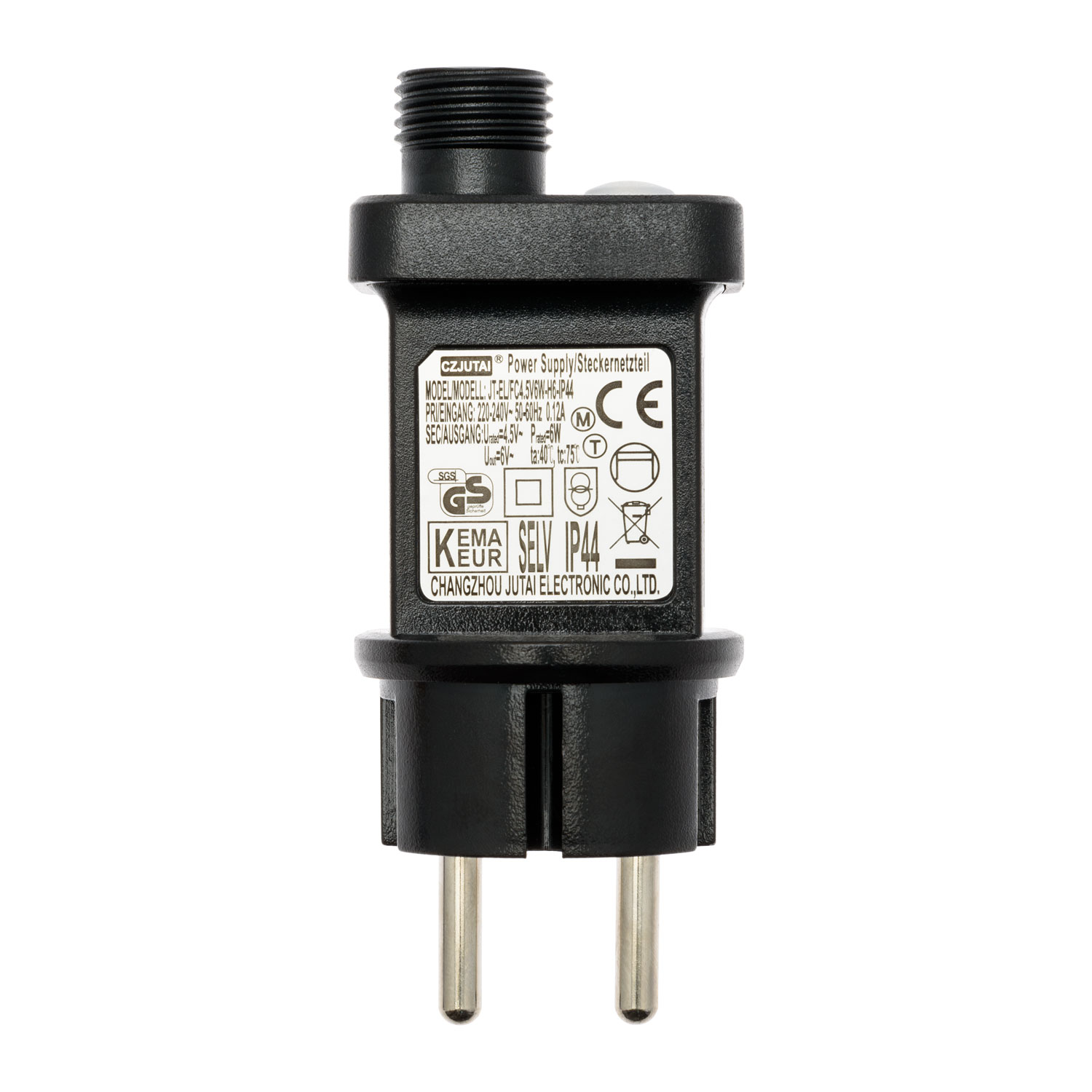
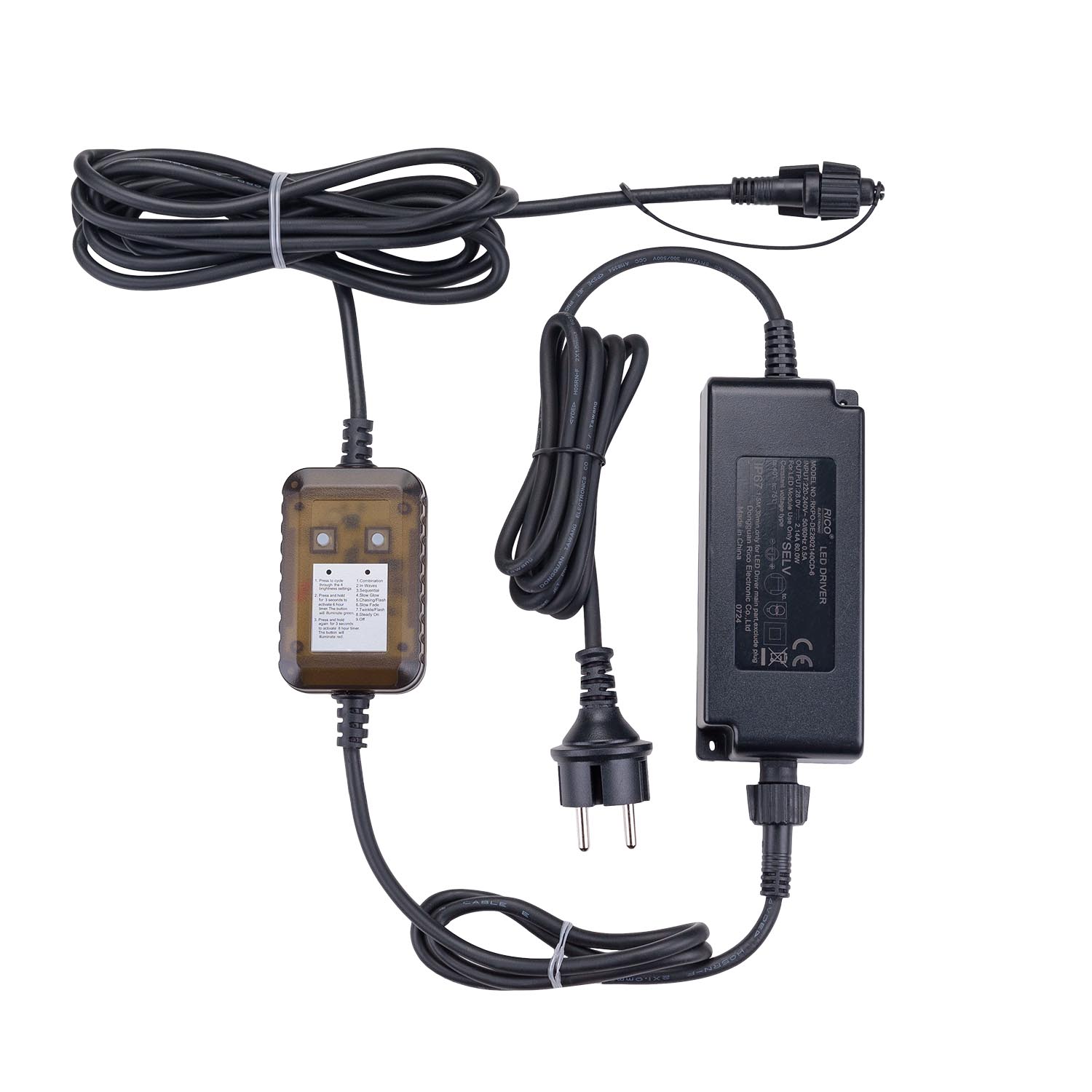
Wall mount power supplies have an integrated plug, cost less and are suitable for low power. The problem is that in cheap products they are often extremely fragile: sometimes a drop from one metre is enough to break the internal electronics. Desktop power supplies, with separate cable and higher-quality components, are more robust and handle higher power levels. They cost more, but they last.
3. Controllers: integrated or external?
Controllers manage light effects, dimmers and timers. To save money, they are almost always integrated into the power supply (you can recognise them by the small button on the plug). A separate controller has better components, handles higher power levels, can be positioned where needed and can be replaced independently. But it costs more, so you will never find it in cheap decorations.
Wall mount power supply
Controller and timer integrated into the plug
Desktop power supply
Power supply with separate controller
CE marking: not all tests are the same
CE marking is mandatory for any light decoration sold in Europe. No exceptions. But CE is not a certification issued by an external body: it is the manufacturer itself that, under its own sole responsibility, verifies the product, compiles the technical file and applies the mark.
Depending on the product, the Low Voltage Directive 2014/35/EU comes into play (for 230V decorations and power supplies), along with the EMC Directive 2014/30/EU and RoHS.
And this is the point: the CE mark on a package does not say how thoroughly that product has been tested. It only says that someone has declared that it is compliant.
The difference lies in the tests behind that declaration. A serious importer has products tested by accredited laboratories - IMQ, TÜV, VDE, SGS, Intertek - which issue test reports according to standard EN 60598-2-20.
Some go further and obtain voluntary third-party certifications such as the ENEC mark, which also includes inspection of the production facility. Others settle for reports from accommodating laboratories, often outside the EU and not accredited, on a single sample that has nothing to do with mass production.
| Independent body | Headquarters | Testing rigour |
|---|---|---|
| IMQ | Italy | Very rigorous |
| TÜV | Germany | Very rigorous |
| VDE | Germany | Very rigorous |
| SGS | Switzerland (global) | Very rigorous |
| Intertek | UK (global) | Very rigorous |
| Non-accredited laboratories | Various (non-EU) | Variable / insufficient |
Assembly and packaging
Even though many processes have been automated, the quality of factory workmanship still matters a great deal. Care in soldering, precision in assembly, quality control on every batch — all these factors affect cost and, above all, the reliability of the finished product.
And then there is the packaging. The use of cardboard with FSC certification (Forest Stewardship Council) guarantees that the material comes from sustainably managed forests or from recycling processes. Does it cost more than a nylon bag or a plastic box? Yes. But it is a choice that has a real impact on sustainability, and that also affects the final price.

Three questions we often answer
1. Will a quality product always work without problems?
No. It would be nice to be able to guarantee that, but it would also be false. Even a product made with the best materials can have a defect. The difference is that quality is not measured on a single piece, but on large numbers: how many returns out of thousands of pieces sold? A serious manufacturer monitors this data and works to reduce it season after season.
2. Are quality decorations produced in China?
Yes. All light decorations are produced in China. The entire supply chain is concentrated there: components, intermediate processing, assembly. It is a fact of the industry.
Some companies have started assembly processes in Europe, but the raw materials and components remain Chinese. Carrying out only the final step in Europe and calling it “Made in EU” is a marketing technique, not an indicator of quality.
What really matters is something else: the quality of the materials chosen (everything we have discussed in this article), the experience and level of the factory, and above all the specifications requested by the importer. Because this is how it works: if the importer asks for a low price, the factory will give it to them. But something will be cut. Always.
3. Is “Made in EU” a guarantee of quality?
No, not necessarily. As we have seen, assembling in Europe does not change the quality of the components. The difference is made by the choices upstream: which materials are specified, what standard the factory is required to work to, and which body certifies the product.
What else affects the final price
So far, we have talked about components and materials. But there are other factors that explain the price differences you see on the market.
1. Loss leader products
Some retailers sell seasonal decorations at cost price or below cost. They make no profit from them, but use them as bait: the aim is to bring the customer into the store (or onto the online shop) and encourage them to buy other products with higher margins.
2. A warranty you cannot actually use
On paper, the warranty is there. In practice, some operators rely on a system that discourages the customer: the store is far away, the proof of purchase has been lost, the waiting times to speak to customer service are endless. The result: the customer gives up, and the cost of the defect remains entirely with them.
3. No continuity in the assortment
This is a huge problem for professionals. Importers who always source from the cheapest manufacturer at the time offer catalogues that change every year. So how can a professional expand the avenue installation they created last year? Good luck: that product no longer exists. For those managing multi-year installations, assortment continuity is not a detail — it is a requirement.
Our approach: Luminal Park professional series
After analysing all the factors that determine the quality of a light decoration, it is only right to explain how we at Luminal Park apply these principles to our products.
We have developed three series specifically designed to meet the highest quality requirements: Connect+, Connect ProLine 36V and PML. These ranges are designed to create impactful, reliable and long-lasting professional displays.
In these series, we make a concrete commitment to every aspect discussed in this article:
Quality of materials — LEDs selected for efficiency and durability, cable cross-sections larger than the regulatory minimums, use of 100% copper and production processes designed to reduce the risk of oxidation as much as possible, even in non-resin-coated products.
Light colour consistency — rigorous LED selection to maintain a uniform light shade across different production batches, a fundamental requirement for professionals working on large installations.
Robust connectors — designed to ensure mechanical hold and long-term resistance, even in the most demanding conditions of use.
These products are designed for those who cannot afford to replace an installation every season and need decorations that work, season after season.
Discover our professional series: Lights for projects.
Conclusions
Choosing a light decoration is more complex than it seems. Behind every price difference there are precise choices in terms of materials, processes, certifications and service. This article is not meant to say that the most expensive product is always the right one — but that knowing what you are buying is the first step to avoiding disappointment.
Answers to the most common questions
From LED quality to cable choice, from connectors to certifications: we answer the most common questions to help you understand what to consider before buying.
A quality outdoor Christmas light is not recognised only by how bright it is when first switched on. The most important differences are found in the materials and construction: selected LEDs, cables with an adequate cross-section, copper conductors, robust connectors, good protection against humidity and oxidation, reliable power supplies and certifications carried out by recognised bodies. To the naked eye, two string lights may look very similar, but after weeks of rain, cold, sun and repeated installations, build quality makes a major difference.
The main difference lies in durability and long-term reliability. Cheap lights often aim to reduce the initial cost by using simpler materials, thinner cables, less robust components or less accurate production processes. Professional lights, on the other hand, are designed to withstand outdoor use better, maintain more uniform brightness, support longer installations and reduce the risk of faults during the season. This does not mean that the most expensive product is always the right one, but that it is important to know what you are buying.
A resin-coated LED is an LED protected by a resin coating, normally designed to improve insulation and reduce the risk of humidity and oxidation compromising the operation of the light. This protection is particularly important in outdoor decorations, where rain, condensation and temperature changes can put electrical components under stress. The difference compared to an LED with simpler insulation is not always visible from the outside, but it can have a major impact on the durability of the decoration.
For an outdoor string light, especially when used in professional installations or over long distances, copper is generally the best choice. It has lower electrical resistance, ensures more uniform brightness along the string light, offers more reliable solder joints and tends to oxidise less quickly. Cables with a copper/aluminium mix can reduce the product cost, but they can lead to greater voltage drop, loss of brightness over distance and more delicate connections over time.
The cable is one of the components that has the greatest impact on the final cost of a light decoration. The conductor cross-section, the material used, the type of outer coating and the quality of assembly all matter. A thinner cable or one made with less efficient materials may cost less, but it can also heat up more, lose brightness over distance or be less resistant to traction, cold and humidity. In outdoor installations, the cable is not a detail: it is a fundamental part of the product’s reliability.
It depends on the voltage. For 230V outdoor installations, a rubber cable is mandatory because it offers protection more suitable for outdoor use. In low-voltage decorations, below 50V, PVC cable is also allowed.
Rubber is still more suitable for more demanding uses: it withstands cold better, remains more flexible and better tolerates traction and mechanical stress. PVC can be fine in low voltage, but in cheap versions it can stiffen, crack or last less if exposed outdoors for a long time.
Connectors, power supplies and controllers are often underestimated components, but they can be decisive for the reliability of a light decoration. Connectors must ensure good mechanical hold and protection against humidity. Power supplies must be correctly sized and built with reliable components. Controllers, if separate from the power supply, can offer greater flexibility, better power management and the possibility of independent replacement. Saving money on these elements can increase the risk of faults, especially in outdoor installations.
No. CE marking is mandatory for light decorations sold in Europe, but not all certifications have the same practical value. The difference also lies in the body that carries out the tests, the rigour of the checks and the technical documentation available. Recognised and strict bodies offer greater assurance that the product has been thoroughly verified. For this reason, in addition to the presence of the CE mark, it is important to assess the seriousness of the importer and the quality of the tests carried out.
For those creating professional lighting installations, assortment continuity is essential. A display may need to be expanded, repaired or replicated in the following years. If the product changes every season or is no longer available, it becomes difficult to replace a section of string light, add new elements or maintain the same lighting effect. This is why a stable and consistent assortment over time has real value, especially for installers, municipalities, hotels, restaurants, shopping centres and businesses working on multi-year projects.
Voltage and IP protection rating must be indicated on the product page, on the label or in the technical documentation. These are essential details for understanding whether the decoration is suitable for outdoor use and whether it operates at 230V or low voltage.
The maximum connectable length must be checked in the technical data sheet or in the product instructions. It is not enough for the connectors to be compatible: each system has a precise limit in metres, segments or power. Exceeding it can cause drops in brightness, overheating or malfunctions.
You need to understand whether the product is part of a series or a seasonal assortment. Before purchasing, it is worth checking whether extensions, power supplies, controllers and spare parts have dedicated codes and are sold separately. For multi-year installations, assortment continuity is an important requirement.
Before leaving lights installed outdoors for extended periods, check that they are genuinely suitable for this use. The IP protection rating is one of the most important details: for exposed and professional installations, an IP67 protection rating is recommended. It is also advisable to periodically check the condition of cables, connectors and power supplies during the season, especially after heavy rain, wind or frost.