Skip to main content Skip to search Skip to main navigation

Starry sky with LED lights: complete guide for events and professional installations

A starry sky with LED lights can completely transform any location, creating an evocative atmosphere for events, weddings and permanent installations.

Date

02.04.2026

Reading time

10 min

Author

Susanna Sinigardi

What is a starry sky with LED lights and why create one

A starry sky is able to amaze guests and light up the atmosphere of the event.

For Luminal Park, however, a starry sky is not simply a decoration: it is a fully customized project, designed in detail and tailored to the specific needs of each customer. Each installation is created with the aim of offering a personalized, functional solution with a strong visual impact.

For this reason, we offer a wide range of products and support the customer through every stage of the selection process, up to defining the most suitable solution.

You can find some ideas on our page dedicated to starry skies.

Who are our solutions designed for?

  • Event and wedding venues
  • Event planners
  • Professional installers
  • Restaurants and Hotels
  • Home spaces

Why use professional lights for a starry sky

On the web and in stores you can find kilometers and kilometers of generic lights that are usually designed to wrap around the Christmas tree.

But a starry sky is a very different project. It is necessary to consider the arrangement of the lights, the quantity required and whether the installation will be temporary or permanent throughout the year. In these situations, it is not practical to manage dozens of transformers, use non-extendable products, have sections of light that cannot be replaced or cables that are too fragile.

Thanks to our experience and continuous innovation, we have developed dedicated lines: modular and extendable systems, designed to offer greater power, flexibility and tailor-made accessories.

These solutions are collected on the Lights for projects page: among these, three stand out for their versatility and are particularly suitable for creating starry skies.

How to design a starry sky: step-by-step guide

Colors, effects, installation contexts… There are many variables and it is useful to clarify your expectations and needs. Here are some helpful questions to ask before choosing the products.

Rame vs Alluminio

Cosa cambia davvero nel cavo di una catena luminosa

VS
Rame 100% Conduttore professionale
Bassa resistenza elettrica
Luminosità uniforme lungo tutta la catena
Saldature resistenti e affidabili
Bassa ossidazione nel tempo
Mix rame / alluminio Conduttore economico
Resistenza elettrica maggiore
Calo di luminosità sulle distanze
Saldature fragili, soggette a rottura
Ossidazione più rapida

2. Where to install it: indoor or outdoor

This aspect significantly affects the choice of light sets to be used. An installation that remains outdoors for several months must certainly be made with professional products specifically designed for this purpose.

On the other hand, if a starry sky is to be created indoors, it is preferable to have a product with lighter cables and less visual impact, possibly better matching the ceiling color (transparent for white ceilings, brown for wooden ceilings, dark color for dark ceilings).

Where will the starry sky be installed and for how long?

  • Temporary outdoor (e.g. single event lasting a few weeks);
  • Long-term outdoor (installation lasting several months: products with IP67 protection rating, robust connectors, resin-coated maxiled, durable cables);
  • Temporary indoor;
  • Long-term indoor (less critical than outdoor, but still worth choosing carefully).
Trasformatore a muro
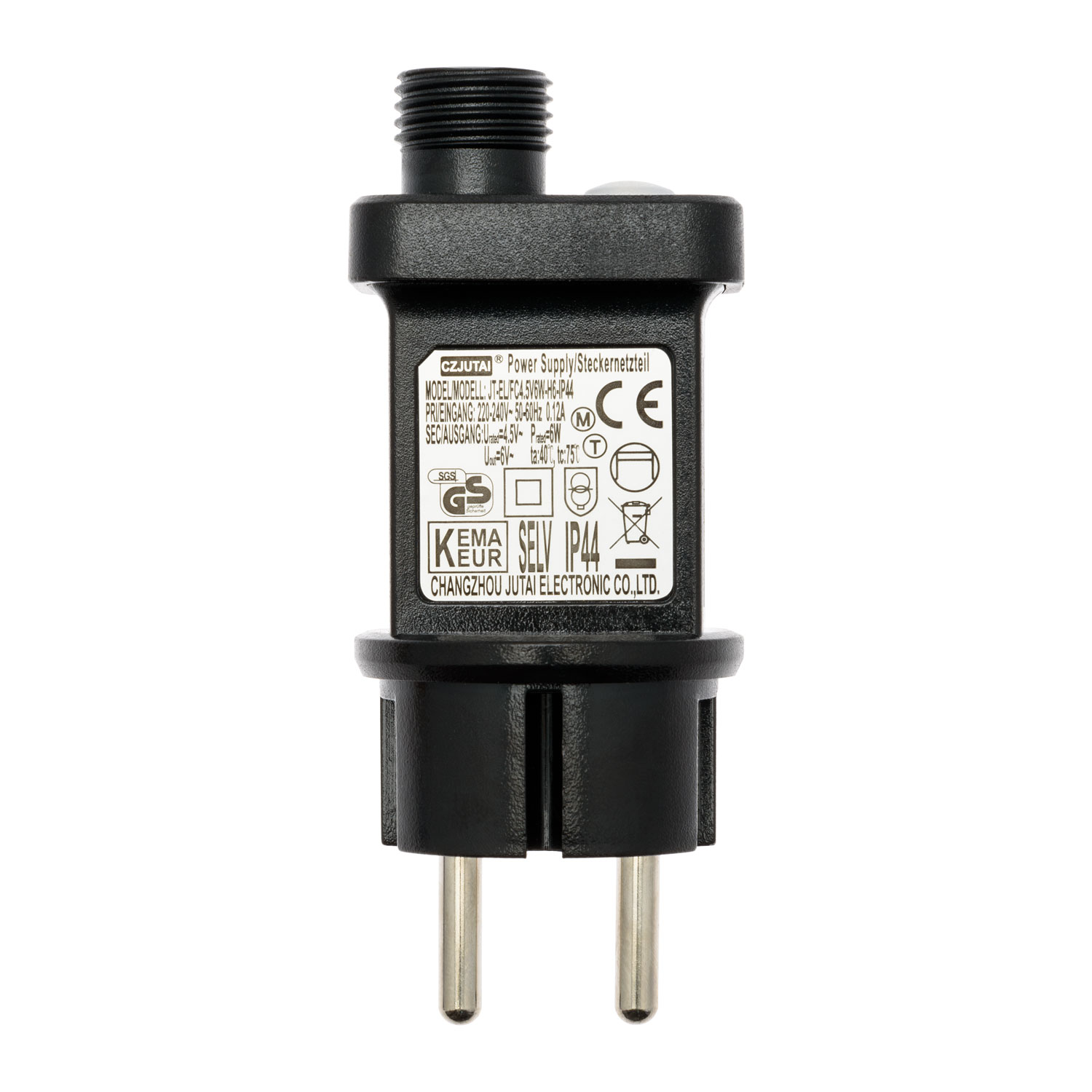
Alimentatore a muro

Classico alimentatore delle luci di Natale con controller e timer integrati.

Trasformatore da tavolo
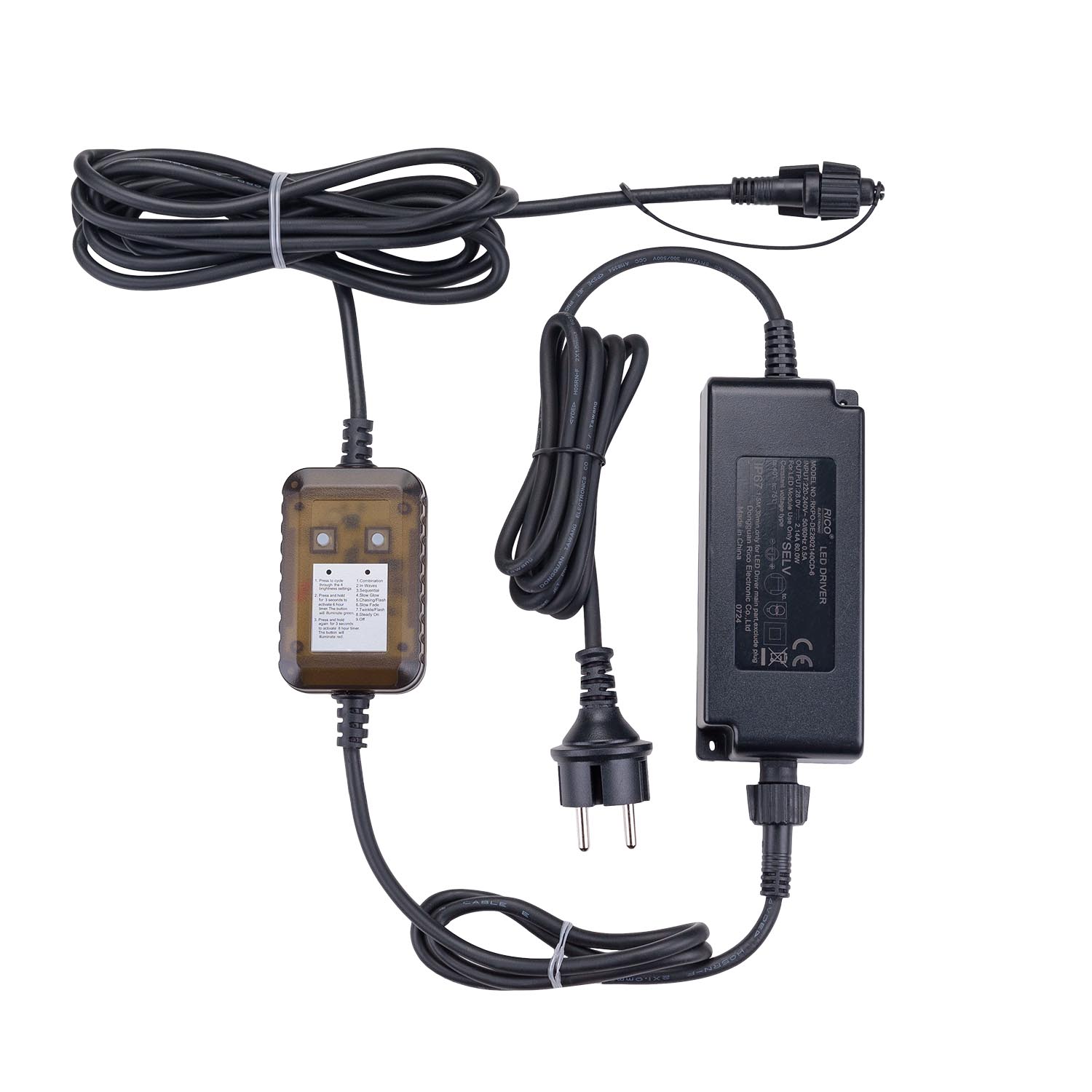
Alimentatore da tavolo con controller separato

Alimentatore con controller separato della serie di prodotti Connect+

3. How to choose the cable color

As mentioned, the cable color is a key element to ensure harmonious integration with the surrounding space. Each option has specific strengths and potential drawbacks, which should be carefully considered during the selection phase.

Starry sky · aesthetics and integration

The cable color changes the way light tells its story

In a starry sky, the cable is not just a technical detail: it can disappear, blend in, interact with the structure or become part of the visual effect. The right choice depends on the environment, materials and the result you want to achieve.

Dark green cable
Natural blending

Dark green cable

A very balanced choice for those who want to reduce the visual presence of the cable, especially in outdoor settings or on dark-toned structures.

Less visible at night Perfect for outdoor use
  • Less visible when it gets dark.
  • Blends well when the ceiling or structure is dark.
  • Perfect for outdoor use.
Brown cable
Material warmth

Brown cable

Brown is the color that best integrates into warm, material-rich environments, where wood becomes an important part of the setting.

Ideal with wood Indoor and outdoor
  • Less visible at night.
  • Perfect where there is a wooden roof or structure.
  • Suitable for both indoor and outdoor use.
Transparent cable
Maximum discretion

Transparent cable

When the goal is to let the light take center stage, transparent is the most discreet and visually lightweight solution.

Barely visible Low voltage only
  • Most discreet solution, the cable is barely visible.
  • Available only in low voltage versions (Connect Proline 36V or Connect+).
  • Mainly used indoors.
White cable
Light amplification

White cable

Here the cable does not completely disappear: it contributes to the overall effect, reflects the light and becomes part of the installation’s brightness.

Perfect on light backgrounds Part of the effect
  • The cable becomes part of the lighting effect.
  • Light is reflected and amplified.
  • Perfect on light-colored ceilings.
  • Barely noticeable during the day.
In summary: dark green is ideal for dark structures and outdoor use, brown enhances wooden environments, transparent is the most discreet choice for low voltage installations, while white becomes a luminous element that integrates perfectly with light-colored ceilings and surfaces.

4. Light color and effects (steady light, flashing or soft pulse)

The warm white of our modular series is the ideal tone for creating starry skies in every season. For outdoor summer events, a traditional warm white is generally preferred, characterized by a more enveloping and intense light.

Those who prefer a less intense warm tone can always opt for soft warm white, available in the professional Connect Pro Line 36V and PML collections.

The choice of lighting effect also significantly impacts the final result. Steady light is always a safe and elegant solution, while flashing can be a valid alternative to make the installation more dynamic, especially in tone-on-tone versions (warm white on warm white).

The possibilities do not end here: our collections offer numerous options designed to create a refined and striking visual effect. An example is the Dual Color Flashing decorations from the Connect Pro Line 36V line, which allow you to quickly switch from cool white flashing to warm white, offering great flexibility of use between summer events and Christmas setups.

Among the most innovative solutions is the Soft Pulse effect, a slow and delicate flashing available exclusively in the Connect Pro Line 36V collection. In this line, it is also possible to alternate the Soft Pulse effect with steady light, easily adapting the atmosphere to the context.

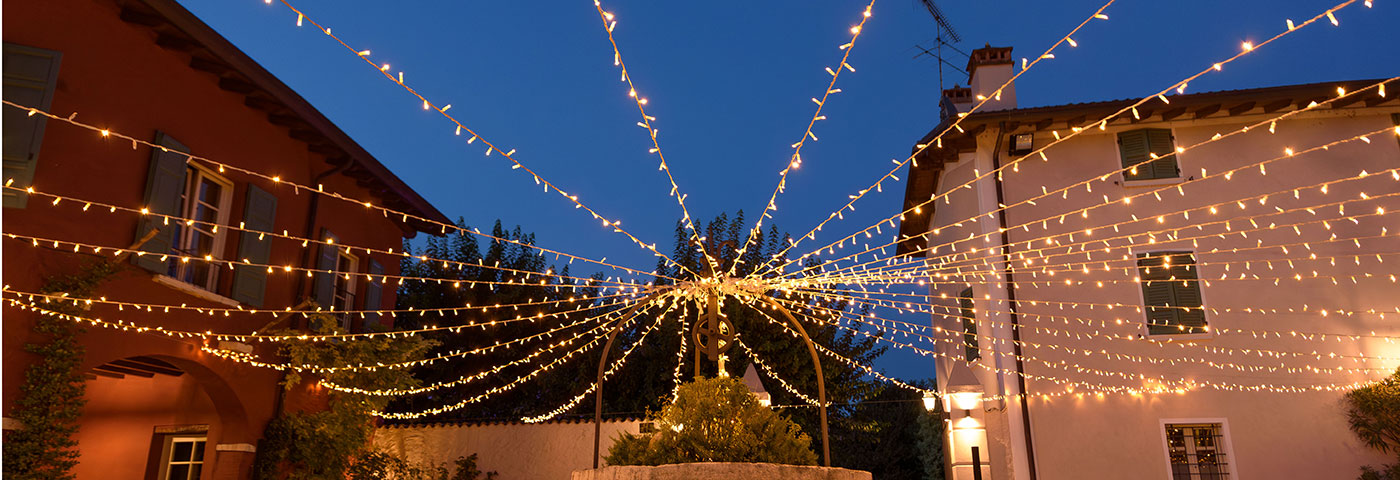
5. Brightness adjustment

During an event, every moment has its own atmosphere, and lighting should follow it. The ability to adjust LED brightness allows you to precisely manage the setting: from softer, more intimate lighting for aperitifs, to brighter illumination during the reception, and finally to a more subdued light for key moments such as the cake cutting or first dance.

External conditions also play an important role: natural daylight or surrounding ambient lighting may require adjustments to maintain the desired visual effect.

All our collections designed for starry sky installations allow brightness adjustment. However, it is important to note that this feature is only available for steady light decorations and is not supported for flashing or soft pulse versions.

Regulations and safety for starry sky installations

Anyone organizing events or managing a venue knows how important it is to create setups that are safe for all guests, including children and animals.

In the field of lighting decorations, the IEC / EN 60364 standard provides clear guidelines for installations in public spaces and in environments where people may come into contact with the system.

In particular, when decorations are installed at a height above 2.5 meters, it is possible to use mains voltage products (230V), provided they comply with regulations and are properly certified—such as the professional PML lighting collection.

Below 2.5 meters, low-voltage solutions must be used to ensure a higher level of safety without compromising professional performance, as in the case of the Connect Pro Line 36V or Connect+ collections.

Technical design: measurements, spacing and installation layout

1. What measurements really matter

Accurately knowing the dimensions of the space to be illuminated is essential. More than the total square meters, it is important to measure length, width, and installation height from the ground. These parameters allow you to correctly calculate the number of lights required, avoiding waste and ensuring uniform distribution without visible differences in intensity between rows.

Installation height plays a key role: the higher the starry sky, the more uniform the light density appears even with greater spacing between light points. On the other hand, lower installations require a higher density to achieve the same visual effect.

As a general guideline, for installations between 5 and 7 meters in height, spacing between LEDs can be around 40–50 cm. For heights between 2.5 and 4 meters, it is advisable to reduce spacing to approximately 20–30 cm to ensure a more even and visually impactful result.